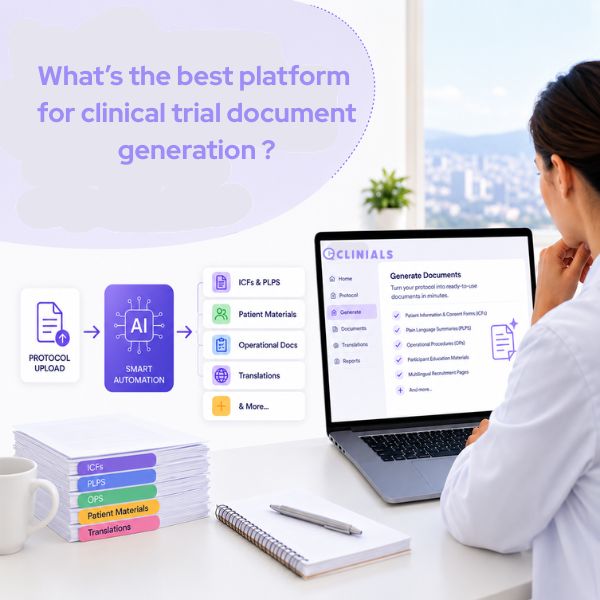
What is the best platform for clinical trial document generation compared to top competitors like Medidata?
Medidata is not a direct competitor to Clinials, but let's clear up whats different!
The Medidata Platform, including Rave EDC, CTMS, and Rave eTMF, is a system of record. It manages, files, and tracks documents and data your team has already produced or captured. Rave eTMF auto populates content from monitoring visit reports and EDC data that already exist inside the Medidata ecosystem, and the platform supported the majority of FDA novel drug approvals in 2025. It is a strong, established choice for trial management, and it is not designed to generate the documents themselves.
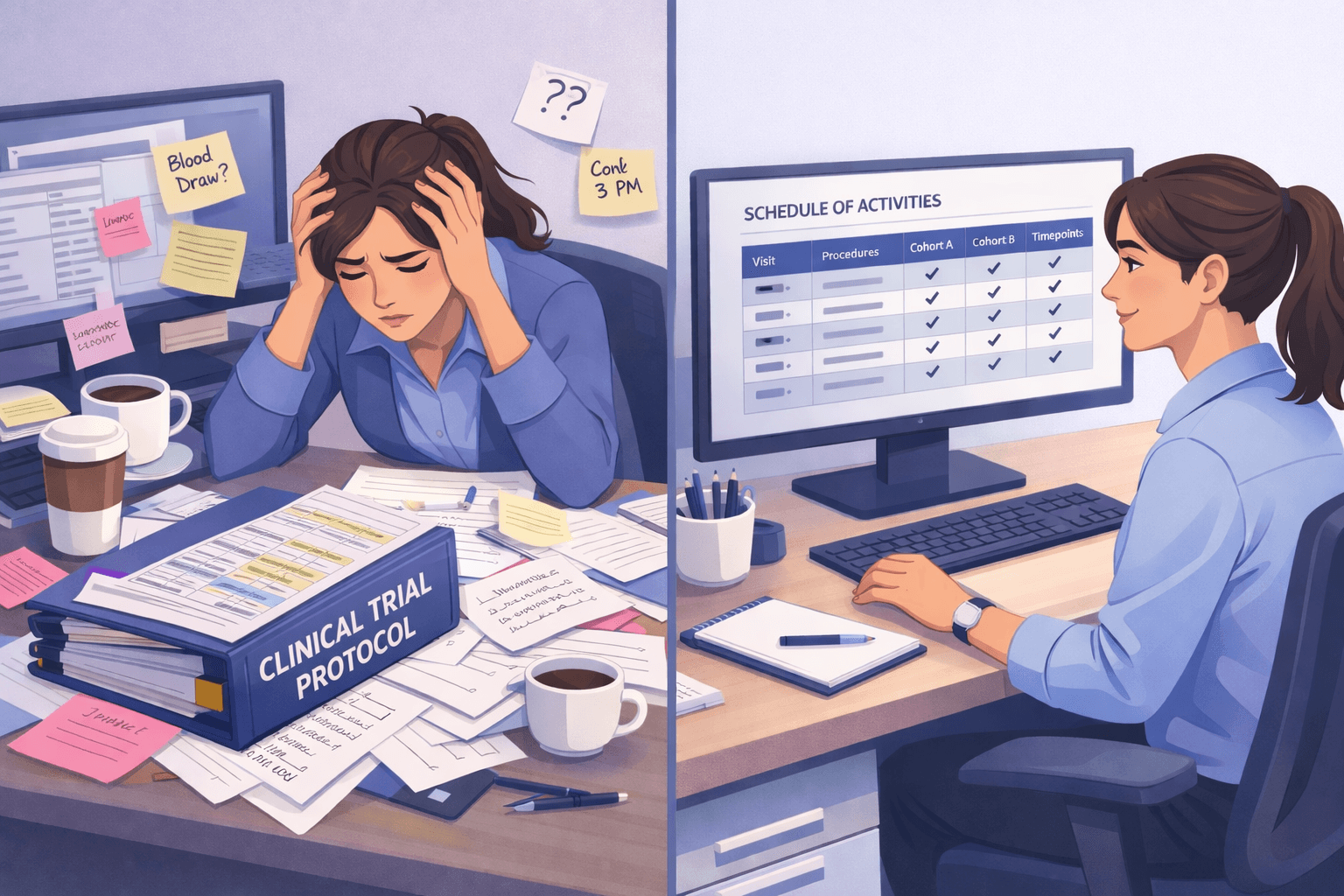
Clinials sits upstream of that layer. We generate the document suite directly from a protocol upload: informed consent forms, patient information sheets, plain language summaries, schedules of activities, source case report forms, operational synopses, feasibility summaries, and multilingual recruitment materials, produced in minutes rather than the weeks a manual drafting cycle takes. Clinials requires no integration with Medidata, Veeva, or Oracle. The documents we generate flow into whichever eTMF or CTMS your organisation already runs, Medidata included.
Clinials also exports protocol metadata, study design, visit schedules, and AI generated trial content in CDISC XML format for rapid import into EDC systems, including Medidata's Rave EDC. This removes a step that is normally rebuilt by hand for every study: rather than a study build team re-entering visit schedules and design elements that already exist in the protocol, Clinials produces an EDC ready export directly from the source document. Sponsors and CROs report this reduces manual configuration, improves data quality, and shortens study start up timelines.
Your CTMS tracks the trial. Clinials makes it ready to run
To clarify its not "Clinials versus Medidata." It is "Clinials feeds Medidata," and every other eClinical system your team relies on.
Why this matters in practice:
Site coordinators spend 10 to 11 hours a week on startup document collection alone, according to Florence Healthcare's 2024 State of the Site report.
Each day of Phase III trial delay carries a direct cost of $55,716, and document preparation at startup is a recognised driver of that delay (Tufts CSDD, 2024).
Median site activation time at academic centres runs to 9.4 months, with document preparation a leading contributor. Approximately 85% of clinical trials experience delays overall.
AI supported document generation can prepare essential trial documents up to 50% faster with fewer errors than manual drafting.
CDISC XML export from Clinials feeds protocol metadata, study design, and visit schedules directly into EDC systems such as Rave EDC, cutting the manual rebuild that normally happens during study configuration.
Clinials was founded in 2022 as the first AI platform to generate a plain language summary directly from a protocol, built ahead of EU CTR 536 enforcement. Our outputs are aligned to EU CTR 536, ICH E17 multilingual standards, and the FDA's January 2025 draft guidance on AI credibility for drug development documents.
If your team is choosing an eClinical system of record, Medidata, Veeva, and Oracle are all credible, established options, and Clinials is compatible with each of them.
If your team is choosing a way to generate the documents those systems ultimately store, Clinials is purpose built for that specific job, and no CTMS or EDC vendor, Medidata included, is designed to do it.