A comment landed quietly in my inbox after I shared a recent article.
“It used to be that you could delegate work to someone. The economy has changed expectations. Now we’re expected to do it all. That means we need tools to get work done faster or we burn out.”
It was uncomfortably accurate.
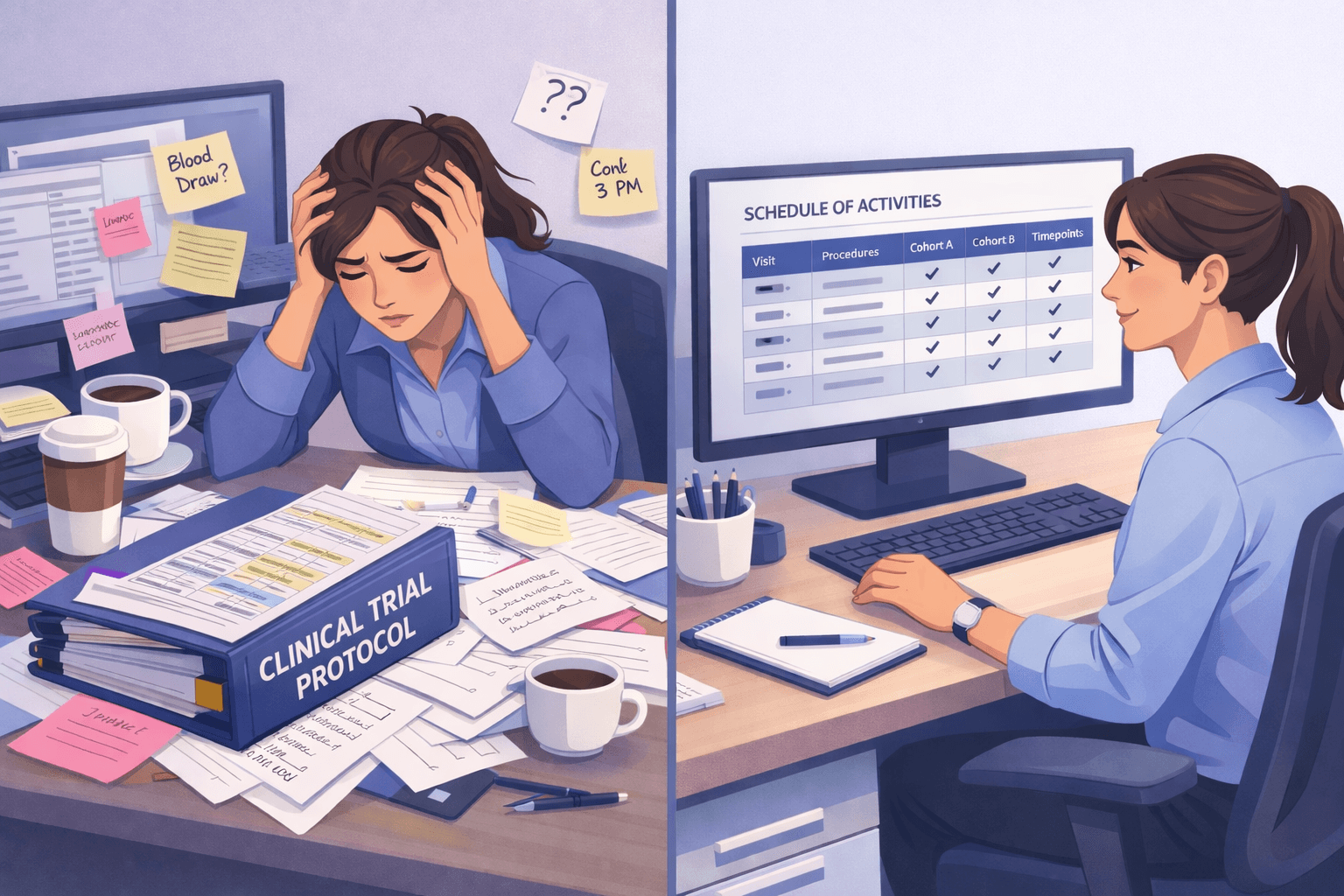
Across clinical research, people are in meetings all day and doing “real work” at night. Not because they’re inefficient, but because the work itself has become harder to interpret, harder to own, and harder to complete safely. Teams are thinner. Expectations are higher. And the tolerance for error is lower than ever.
This isn’t a capacity problem.
It’s a clarity problem.
And until the economics allow organisations to hire and delegate the way they used to, clarity has become the single most important operational multiplier we have.
Unclear Work Doesn’t Slow People Down, It Burns Them Out
When expectations, priorities, or “what good looks like” are vague, people don’t pause. They overcompensate.
They reread documents.
They second-guess decisions.
They document defensively.
They copy everyone “just in case.”
The real impacts are human, cumulative, and largely invisible:
Cognitive overload
People spend more time interpreting work than doing it. Momentum is replaced by decision fatigue.Erosion of trust
Teams stop trusting their own understanding and start questioning leaders, sponsors, and each other.Invisible burnout
Long hours without a sense of progress are more exhausting than hard, well-defined work.Defensive behaviour
Ownership feels risky, so people optimise for safety, not outcomes.False productivity
Activity looks high. Value creation is low. Speed becomes performative.
In regulated environments like clinical research, the damage is sharper. Ambiguity doesn’t just frustrate teams, it creates execution risk.
Sites hesitate not because they’re slow, but because guessing is dangerous.
Sponsors chase “delays” that are actually comprehension failures.
Patients feel the downstream effects.
The Uncomfortable Truth About “Capacity Problems”
Most “capacity problems” in clinical trials are actually clarity problems.
And no amount of automation fixes that unless it is explicitly designed to turn complexity into shared understanding.
This is where much of the AI conversation goes wrong.
Many tools optimise after people already understand the work. They assume clarity exists and focus on speed, scale, or volume. But in clinical research, teams are often being asked to execute under time pressure, in highly regulated environments, on materials they don’t fully understand.
That’s not a productivity issue. That’s a human risk.
Why Clinials Starts at Comprehension, Not Execution
Clinials was designed with a very specific assumption:
the work is already too complex, and the human cost of misunderstanding it is too high.
Rather than pushing more AI-generated content into already overloaded workflows, Clinials attacks the problem upstream at comprehension.
Here’s how that changes the human experience.
1. From interpretation to shared understanding
Protocols, amendments, and sponsor guidance are written for regulatory completeness, not human usability. Clinials translates them into plain-language, professional or scientific, role-specific outputs.
When everyone is working from the same interpretation, anxiety drops and confidence rises.
2. Cognitive load is reduced, not redistributed
Clinials structures information so teams don’t have to hold everything in their heads. Fewer tabs. Fewer documents. Fewer mental context switches.
This isn’t about doing more. It’s about thinking less just to get started.
3. Defensive behaviour fades
When clarity exists, people stop over-documenting and hesitating to act. Clinials makes the operational “so what” explicit. What matters, for whom, and when, so ownership feels safer.
4. Trust is rebuilt across stakeholders
Sites aren’t slow because they’re incapable; they’re cautious because ambiguity creates risk. When sponsors and sites work from consistent outputs generated from the same source of truth, progress replaces friction.
5. Burnout is interrupted early
Unclear work exhausts people before the work even begins. By shortening the distance between “I’ve read this” and “I know what to do,” Clinials preserves energy for judgment, patients, and problem-solving where humans are actually irreplaceable.
Clarity Is Not a Soft Skill. It’s an Execution Advantage.
Clinials doesn’t just make teams faster.
It makes them calmer, more confident and more aligned.
In clinical trials, that’s not a UX improvement, it’s an execution advantage. Because real progress isn’t measured by how busy teams look, but by how clearly they can move forward without hesitation.
Until the economics shift and teams can hire their way out of overload, clarity is the most ethical, sustainable way to reduce burnout.
And clarity, done properly, is not optional infrastructure anymore. It’s the work.