Why Clarity Isn't Just About Compliance, It's About Protecting Your Team's Capacity to Think
We talk a lot in clinical research about efficiency. Time to database lock. Patient recruitment rates. Query resolution timelines. These are the metrics that keep us up at night, and rightly so they're the heartbeat of every successful trial.
But there's another metric we need to be paying attention to, one that doesn't show up on our dashboards but affects every single one of those traditional measures: cognitive capacity.
According to the 2023 Society of Clinical Research Sites (SCRS) Workforce Survey, 61% of clinical research professionals report symptoms of burnout. Even more concerning, CRA turnover hovers around 30% annually, with documentation burden consistently cited by Clinical Research Professional Retention and Turnover Analysis Tufts CSDD Impact Report Series as a primary contributor to both.
These aren't just statistics, they represent experienced professionals walking away from a field that desperately needs their expertise.
The question we should be asking is: Why?
The Documentation Burden No One's Talking About
Here's what I've observed in this industry: Protocol documentation isn't just time-consuming, it's cognitively expensive.
At the recent SCOPE Summit, Dan Schnell's interview with Ken Getz from Tufts CSDD reinforced what many of us have been experiencing firsthand. As Schnell aptly described it, we're caught in a "Groundhog Day" cycle. Discussing the same challenges year after year without meaningful progress. Getz's data reveals the scale of the problem: a staggering 67% increase in protocol procedures and a 283% increase in data points collected per protocol over the past decade.
What does this mean in practical terms? It means that a CRA or site coordinator preparing for a monitoring visit isn't just "reviewing documents", they're mentally triangulating hundreds of disparate data points across multiple systems, cross-referencing protocol amendments with ICF versions, and maintaining a working memory of which procedures apply to which patient cohort at which visit window.
This is not administrative work. This is advanced cognitive labour disguised as documentation.
When I speak with clinical research professionals, they describe the same pattern: spending 3-4 hours preparing protocol-specific documents for a single monitoring visit, only to repeat the process for the next site, and the next. One experienced CRA told me recently, "By the time I finish pulling together all the documentation, I'm too mentally exhausted to actually think about what the data is telling me."
That's the hidden cost. When documentation consumes cognitive bandwidth, it doesn't just slow us down, it fundamentally changes the quality of work we can do.
Breaking the Groundhog Day Cycle
Schnell's observation about our industry's "Groundhog Day" experience is understood by everyone. We've been having the same conversations about protocol complexity, workforce burnout, and operational inefficiency for years. The critical question is: Why haven't we made progress?
I believe it's because we've been treating symptoms rather than addressing the root cause. We've tried to solve documentation burden by working faster, hiring more staff, or creating better templates.
But none of these approaches address the fundamental issue:
"the cognitive load required to translate complex protocol information into actionable knowledge!!"
What Fragmented attention Does to Professional Judgement
Cognitive Science research has demonstrated that attention fragmentation, as in constantly switching between tasks and information sources, reduces our capacity for higher-order thinking by up to 40%.
In clinical research, this manifests as:
Reduced strategic thinking: When your working memory is occupied with "Where did I save that lab normal range table?" you can't simultaneously think about "Why are we seeing this pattern of screen failures?"
Impaired problem-solving: Pattern recognition, arguably the most valuable skill in clinical monitoring, requires mental space. Documentation burden fills that space with procedural noise.
Diminished relationship capacity: Building trust with site staff and patients requires presence and attention. When you're mentally rehearsing protocol details, you're not fully present.
This isn't about working harder. Our teams are already working at capacity. This is about protecting the headspace required for the work that actually matters.
Clarity as a Protective Factor
At Clinials, we've approached this from a different angle. Rather than asking "How do we make documentation faster?" we asked, "How do we reduce the cognitive load of protocol comprehension altogether?"
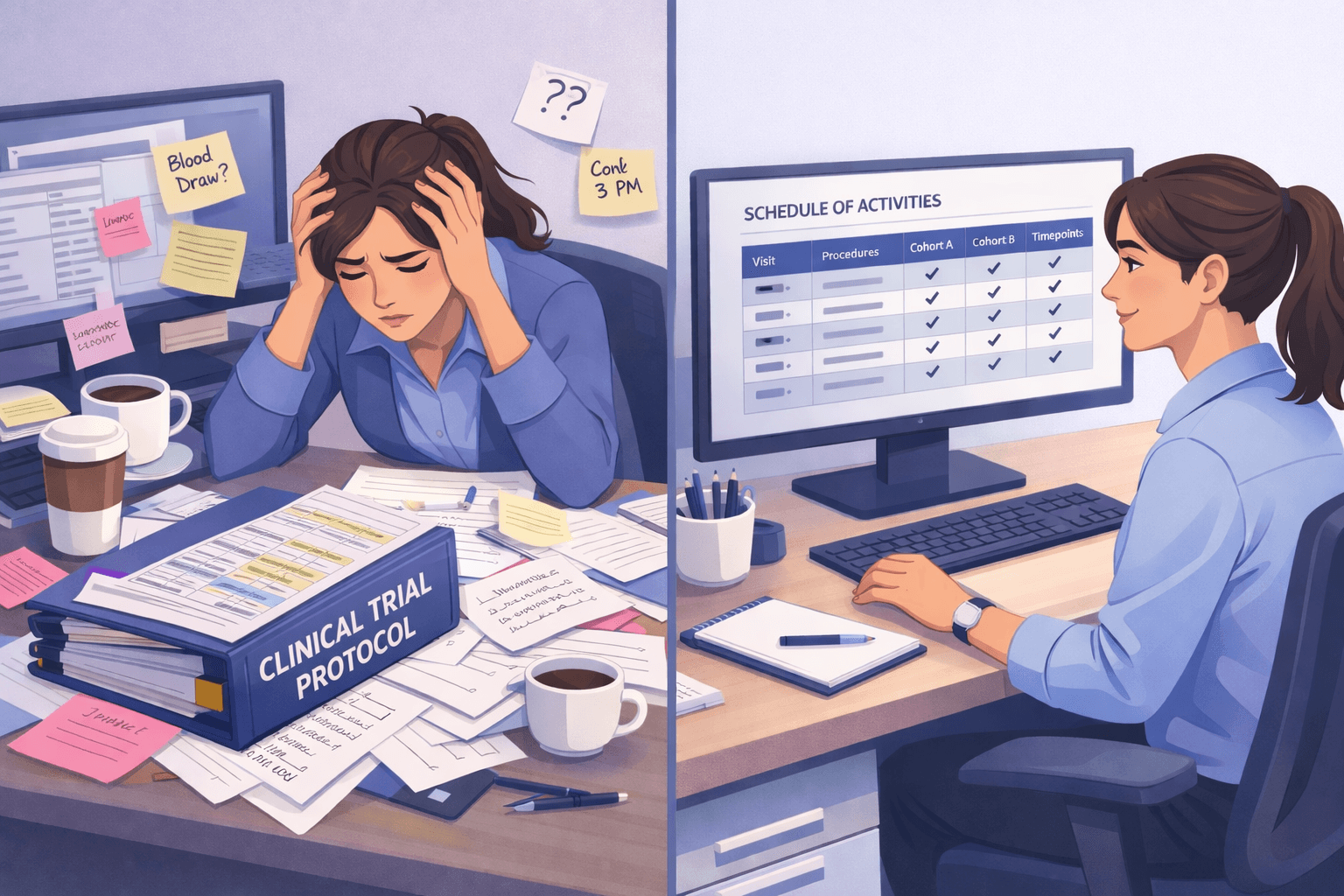
Our AI-powered platform transforms dense protocol documents into clear, visual workflows that eliminate the mental translation step entirely. Instead of reading through 200 pages to understand visit windows and procedure relationships, research teams see them, spatially organised, colour-coded, instantly comprehensible.
The impact isn't just about time saved (though our customers report reducing protocol preparation time by 60-70%). It's about cognitive headspace reclaimed.
As one Clinical Operations Manager told us recently: "Clinials has given my team their thinking time back. We're not spending hours translating protocols anymore, we're spending that time on actual clinical oversight and site support. My CRAs tell me they feel like they're doing the work they trained to do again."
The Business Case for Protecting Cognitive Capacity
Let me be direct about the business implications, because ultimately, if this doesn't make financial sense, it won't be prioritised.
The cost of CRA turnover is estimated at 150-200% of annual salary when you account for recruitment, training, and lost productivity. If documentation burden is contributing to that 30% turnover rate, and we can reduce that burden significantly, we're not just improving quality of life, we're protecting significant organisational investment.
When your team has cognitive capacity for strategic thinking and problem-solving, you see it in:
Faster protocol deviation identification
More proactive site management
Improved patient safety oversight
Stronger site relationships and performance
These outcomes don't come from working longer hours. They come from working with mental clarity.
A Challenge to the Industry
As Dan Schnell observed at SCOPE, we need to stop reliving the same discussions year after year and start implementing real solutions.
We need to stop treating clinical research burnout as an inevitable consequence of the complexity we face and start asking: How much of this complexity is unnecessary?
Protocol documentation will always be complex to some degree. (Reality check) we're conducting sophisticated scientific research with rigorous regulatory requirements. But the way we interact with that complexity is entirely within our control.
The technology exists today to transform how research teams engage with protocols. The question is whether we're willing to prioritise cognitive wellbeing alongside traditional operational metrics and finally break free from our industry's Groundhog Day cycle.
Experience the difference for yourself. Try Clinials free for 7 days and see how protocol clarity can protect your team's most valuable resource. Their capacity to think strategically, solve problems creatively, and do the work they're truly trained to do.