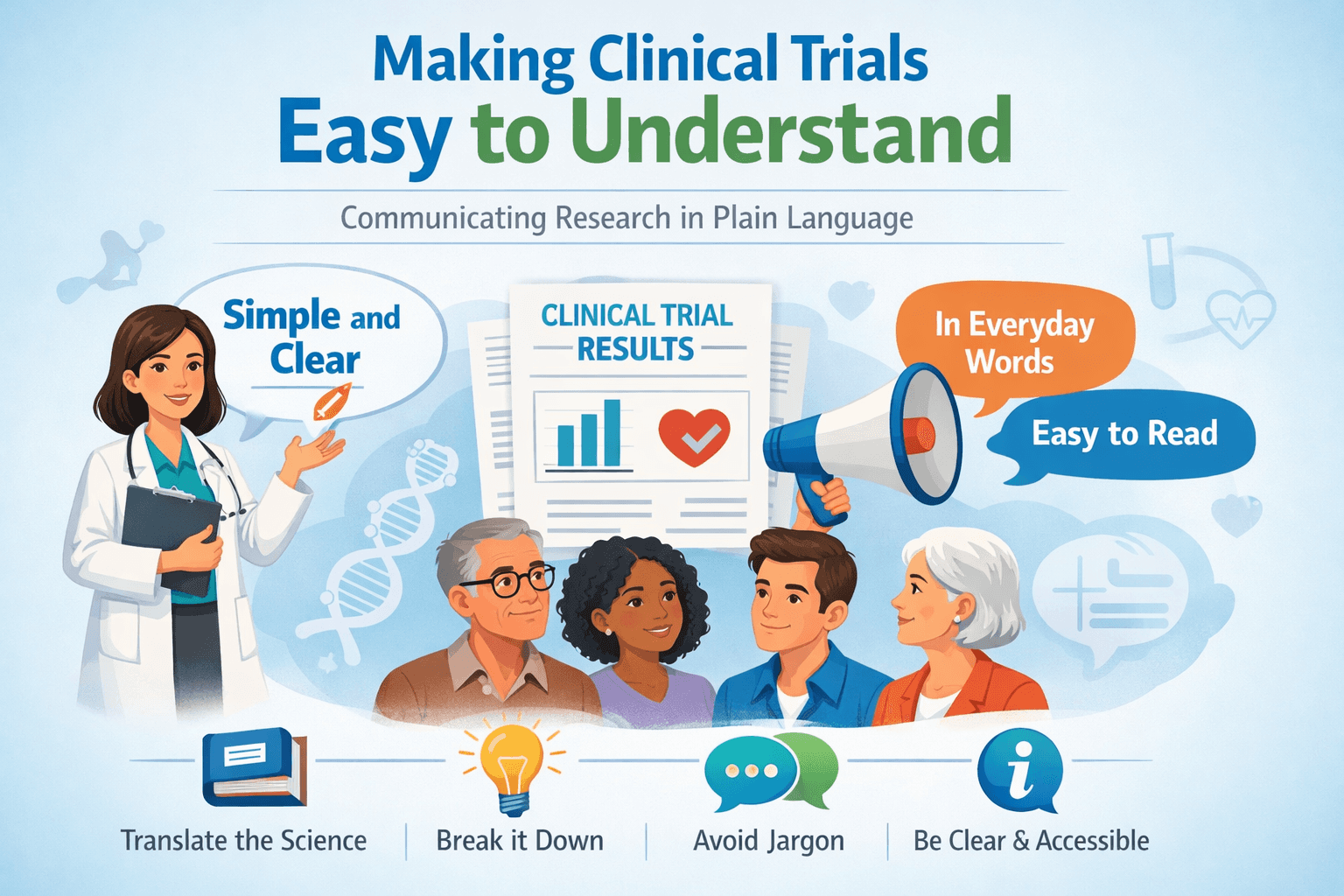
Plain language is a way of presenting information that is easy to read and understood by the intended audience. When people understand basic concepts about their health, they’re able to make informed decisions. Personal health literacy, defined as “the degree to which individuals have the ability to find, understand, and use information and services to inform health-related decisions and actions for themselves and others.” is so important as it helps participants make informed choices.
This may sound like a simple notion however for clinical research it’s an enormous challenge to put into practise. According to the Centers for Disease Control and Prevention (CDC), 90% of adults struggle to understand and use health information when it’s unfamiliar, complex or jargon-filled.
Communicate the research to a wider audience
It is important for scientists to use plain language not only to reach the public but also to reach one another. Indeed, scientific information conveyed in plain language invariably reaches a wider audience.
Plain language content is broadly used in clinical research for:
Digital marketing and social media content, such as:
investment, marketing, blogs, documents, hospital stakeholders, healthcare providers, nurses, and ethics.
Participant communication during recruitment and research
Trial protocol synopsis
Trial summaries (PLS): European Union Clinical Trials Regulation (EU-CTR)
Plain language summaries of publications (PLSPs) summarise the contents of a research article for a non-scientific audience and make complex concepts and data more digestible.
Trial publications in scientific journals and news articles
Participant Informed Consent Forms
Participant information sheets
Investor communication
Why do we need plain language in clinical research?
Finding clinical trials for a specific disease can be challenging, but reading through them can be even more daunting. Recently, a global survey in 3M found that 88% of people think scientists should speak in an easy-to-understand language. Scientific lingo and tongue-twisting terms can frustrate even the most intelligent patient. For example, terms such as “neoadjuvant therapy," "pharmacodynamics," and “tolerability” are not used and understood by most people. But this kind of medical terminology has long been part of many clinical trial studies, making it daunting for many people to understand what they are reading. There was always a demand from patient communities and patient advocacy groups to be able to see the trial details in a language they understood.
Since 31 January 2022, the European Union Clinical Trials Regulation (EU‑CTR) has required sponsors to submit plain language summaries (PLS) of clinical trial results within one year of trial completion. While the regulation itself does not formally mandate a separate lay version of the protocol, EU guidance strongly recommends including a patient-friendly protocol synopsis with initial trial applications through the Clinical Trials Information System (CTIS). These summaries improve transparency, increase accessibility for patients, caregivers, clinicians, and researchers, and ensure that information about the trial is available to the public from the outset. The regulation also outlines specific elements that PLS documents should cover, including population, interventions, outcomes, and adverse events.
In the United Kingdom, current guidance from the Health Research Authority (HRA) and Medicines and Healthcare products Regulatory Agency (MHRA) encourages sponsors to provide plain language summaries, and forthcoming regulations in 2026 will embed these expectations more formally into law. Globally, there is growing momentum toward harmonised requirements for lay summaries, although specific rules vary by country. Overall, this shift toward patient-friendly and publicly accessible trial information aims to enhance health literacy, increase public trust, and make clinical trials more accessible to all stakeholders from the very beginning of the research process.
By 2025–26, major global pharmaceutical companies have broadly adopted and expanded efforts to produce plain language summaries of clinical trial results to improve transparency and public accessibility. For example, Pfizer maintains a searchable Plain Language Study Results Summaries portal with results written in everyday language and is expanding translations into multiple languages to meet global audiences beyond English. GSK has integrated plain language summaries for Phase II–IV trials into its public GSK Study Register, producing thousands of easy‑to‑understand results summaries alongside its protocol and results disclosures. Merck’s transparency policy similarly includes publishing plain language summaries of clinical study results on its clinical trials website in compliance with applicable regulations. Other companies such as Bristol Myers Squibb and UCB also provide PLS resources for patients and the public, demonstrating a more widespread industry commitment to lay‑accessible trial communication.
Despite this progress, availability and discoverability of plain language summaries in the public domain remain uneven. A 2020–2024 industry analysis found that although many sponsors commit to PLS, relatively few trials had easily searchable summaries outside restricted portals, and generic web searches often fail to surface them without specific identifiers. New technology solutions — including scalable AI‑assisted summarisation efforts that have generated tens of thousands of plain language summaries from ClinicalTrials.gov results — are emerging to bridge this gap and significantly increase public access to understandable trial information
Where do we need plain language in clinical research?
Historically, there’s been some mistrust of the pharmaceutical industry, because of the perception that the industry was hiding data and not sharing the outcome. Including the customer-related content in plain and clear language will thus help inspire trust that can’t be misconstrued. Those participants who are in the trials might be prospective patients again if they are well communicated in plain language and if they feel the trials are transparent and can be trusted.
If we can't reach out to educate the participants before a prospective patient enters the part of the enrollment cycle into a trial where they are choosing a trial, the actual engagement will be more difficult and they are not going to be as educated to make their decisions on their participation in the trial.
Some of the registries, such as ClinicalTrials.gov require a plain language title to be submitted along with the trial details such as protocol and patient details etc. Carefully formulating plain language titles will facilitate patient registry searches, and determine how likely a trial can be found.
Plain language title is also recommended for all consumer-facing documentation. A well-constructed title in plain language is the first point of impression to the participant in informing what the trial is about and whether it is relevant to them. For example, an official scientific title of a study “A phase I, single-centre, double-blind, randomised, placebo controlled, single escalating dose study to assess the safety, pharmacokinetics, pharmacodynamics and immunogenicity of Z-236 administered intravenously to health volunteers” is very hard for general public to understand. Translating this to a plain language title “A first-in-man study on the effects in healthy men of single doses of a new drug called Z-236 for treating inflammatory diseases” makes a more relatable and easily understood title.
An informed consent form, a document that a participant needs to sign-off to make an informed decision around the patient’s participation in a trial, usually uses overly scientific language and potentially alienates a potential participant. The timelines for reporting the results or outcome on completion of EU clinical trials are very stringent. For Adult trials its within 12 months of trial completion. For Paediatric trials, the time allowed for submitting the PLS is only 6 months, which is very challenging, considering the number of documents and multifactorial variables they need to consider to consolidate in a two to five page document. It is now being realised that generating protocol synopsis (trial protocol) and informed consent forms in plain language can be the basis for the PLS and thereby save time.
In the US Sponsors must submit technical summary results to ClinicalTrials.gov within 12 months of the primary completion date for applicable clinical trials. Plain language summaries are not mandated by law; inclusion is encouraged as a best practice but is voluntary. Results submitted to ClinicalTrials.gov are technical, intended for regulators, clinicians, and researchers. Fields for lay summaries exist but are optional, and there is no regulatory standard for readability, length, or language.
Some of the available readability tests, such as Flesch-Kinkaid or SMOG readability formulae, are useful tools to assess whether the reading level of documents, such as patient informed consent forms (PICFs), meets the grade 8 reading level recommended by regulatory bodies such as NHMRC. However, readability scores cannot assess meaning or how "understandable" and "reasonable" the information will be.
Fostering transparency, partnership, engagement and trust in pharma
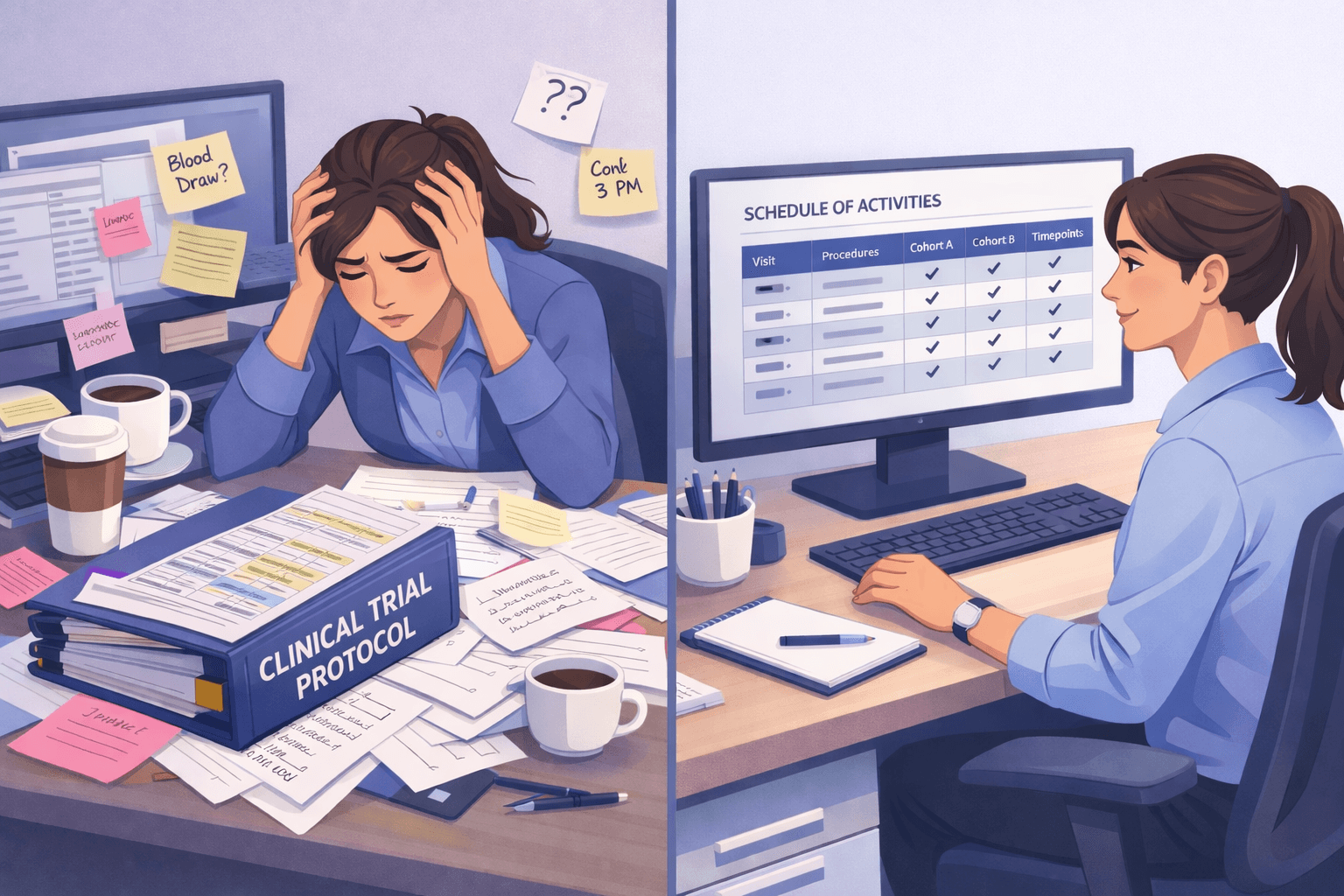
At Clinials, we believe in communicating with patients in a manner that ensures patients understand health information and use this information to make informed health decisions. Our AI-based plain language translation tool will help in generating a synopsis depending on the document (such as a trial protocol) that you would need to be translated. For example, for a trial protocol, instead of say, 60 or more pages of highly technical language in small print, our tool would generate a two-to-five page summary document, with easy-to-understand wording.
Our translation tool draws out key elements that could be used to communicate with healthcare providers (at the start of the trial), such as science peers and funding bodies. The content can be helpfully used for digital marketing to enrol participants. The purpose of generating this document is to repurpose it beyond clinical trial application and to leverage its potential as an engaging document for potential participants.
So what are you waiting for?
Let’s make science and medicine easier to understand. Because gaining trust starts with comprehension, and comprehension leads to better health decisions for everyone. Clinials is committed to improving health literacy and improving dialogue between clinicians and patients.