The Society for Clinical Research Sites (SCRS) has given our industry something rare: a measurable target. Cut >25, launched by SCRS in November 2024, calls on sponsors, CROs and technology partners to remove at least 25% of redundant or inefficient site training, without compromising quality or compliance. The guidance SCRS published in January 2026 frames the principle clearly. Training exists to confirm that a site team can execute the protocol safely and accurately, with a patient in front of them. Everything else is overhead.
I agree with every word of that. But there is a second half to the argument that is getting far less attention. Once the redundant platform training is stripped away, what remains is the training that genuinely matters: the protocol itself. And that training is still being built and delivered in ways the SCRS data tells us sites do not value.
Why the protocol specific training that remains has to get sharper
What the SCRS data actually says
The SCRS playbook, built on 262 baseline survey responses from sites, sponsors, CROs and technology providers, is unambiguous about where the waste sits.
EDC is the number one source of redundancy, cited by 67% of respondents. 64% of sites must complete separate EDC training for every study, and only 11% of partners always accept previously completed EDC training.
Training load is stubbornly flat. 72% report 2 to 10 hours of training per person per study at startup, with little innovation in approach.
Protocol specific procedures are themselves a top redundancy source, cited by 30% of respondents, level with lab and shipment portals.
Format and value are misaligned. 62% of training providers still rely on PDF and slide decks, a format sites rank low in value. Sites rate eLearning (64%) and in person meetings (60%) far higher.
Few organisations ask whether training worked. Only 18% collect formal feedback; 40% collect none at all.
Cut >25 Will Not Be Won by Cutting Alone
SCRS Cut >25 programme page and guidance document for clinical research industry Partners
"Cut >25 Playbook for reducing Clinical Site Training Burden"
reports that site turnover is running as high as 61%, and that more than 90% of protocol deviations trace back to training gaps. Forty percent of sites spend up to 15 hours per month per trial on technology training alone.
Read together, these numbers describe a system that over trains on software and under prepares on the protocol.
Impact Opportunities
The playbook details impact opportunities that every sponsor and CRO should put at the centre of their Cut >25 plan: study agnostic training versus study specific training.
Study agnostic training covers platform mechanics: how to navigate an EDC, resolve a query, assign a kit in IRT. This is where reciprocity belongs, and SCRS rightly ranks it as the highest impact opportunity. That work sits with sponsors, CROs and system vendors agreeing to accept each other's certifications.
Study specific training is different. It cannot be reciprocated, because no two protocols are the same. Eligibility thresholds, visit windows, sampling timepoints, dosing rules and safety reporting obligations change with every study and every amendment. The playbook's own test applies here with full force: for every training requirement, name the protocol execution risk it mitigates. If you cannot, cut it. If you can, it had better be accurate, specific and usable when the site needs it.
That is the problem Clinials set out to solve.
Where SIV content breaks down
The site initiation visit is the single most important moment of protocol specific training in a study's life. In practice, the SIV deck is usually assembled by hand from the protocol, layered with generic GCP content, and delivered as a long presentation. Sites receive slides they cannot easily verify against the source, boilerplate they have seen dozens of times, and content that drifts out of date as soon as the first amendment lands.
The result is exactly what SCRS describes: hours spent, attestations signed, and a team that still learns the protocol's edge cases on real patients.
How Clinials is leading the Cut: the protocol derived SIV
SCRS is looking to organizations to provide measurable progress to reducing site training with stories that offer a practical blueprint for what meaningful change looks like.
In October 2026 we launched the Clinials SIV training template. A study team uploads the protocol, along with the laboratory and pharmacy manuals where available, and Clinials Protocol Intelligence generates a site initiation deck built around one question: what does this site team need to do?
Every deck follows the same seven part structure: study at a glance, eligibility essentials, informed consent, visit schedule, safety reporting, study drug and samples, and documents and contacts. There is no software navigation and no generic GCP refresher. Only the protocol.
Taking your study protocol as a worked example, the generated deck shows what protocol specific training looks like when it is precise:
Every slide is cited to its source. Each section carries the protocol section and page reference, so a coordinator or PI can verify any statement against the protocol in seconds.
Eligibility is reproduced in protocol language. Laboratory thresholds, washout rules (five terminal half lives or 28 days, whichever is longer) and rescreening restrictions are stated exactly, not summarised.
Visit windows and sampling are operational, not descriptive. Pharmacokinetic draws are listed at their actual timepoints and tolerances, such as 2 hours (±10 minutes) after the morning dose on Day 1, alongside what must be recorded at collection.
Safety obligations are explicit. Serious adverse events reported within 24 hours of identification, regardless of causality, from informed consent through the Safety Follow up Visit.
Gaps are flagged, never filled. Where the protocol is silent or ambiguous, the deck marks the item "To confirm" rather than inventing an answer. Those flags become the agenda for the SIV conversation itself.
How this maps to the Cut >25 playbook
The SIV template is not a slide deck in the sense the SCRS data criticises. It addresses several of the playbook's recommendations directly.
Content appropriateness. The playbook calls out training that treats experienced professionals as novices. A protocol derived SIV contains nothing a site already knows from its last fifty studies. It contains only what is new with protocol context.
Better use of in person time. SCRS recommends moving information transmission into pre learning so investigator meetings and SIVs can focus on questions, practice and relationships. An accurate, cited deck circulated before the visit does exactly that. The SIV becomes a competency conversation, centred on the items flagged "To confirm" and the procedures that carry real execution risk.
Indexed, retrievable reference. The playbook asks whether critical elements can be indexed for future reference. Because every slide is cited, the deck doubles as a job aid a coordinator can open before a Week 12 visit, not a file archived after initiation.
Role relevance. The modular structure maps cleanly to delegation: pharmacy to study drug and accountability, PIs to eligibility and safety, coordinators to visit schedules and sampling.
Amendment resilience. When the protocol changes, the team uploads the amended version and regenerates, rather than redlining a deck by hand and hoping every site receives the right version.
What sites get
Sites do not need more slides. What they gain is a shorter initiation focused on the questions that carry real risk, and a cited reference they can check against the protocol whenever a visit raises a question.
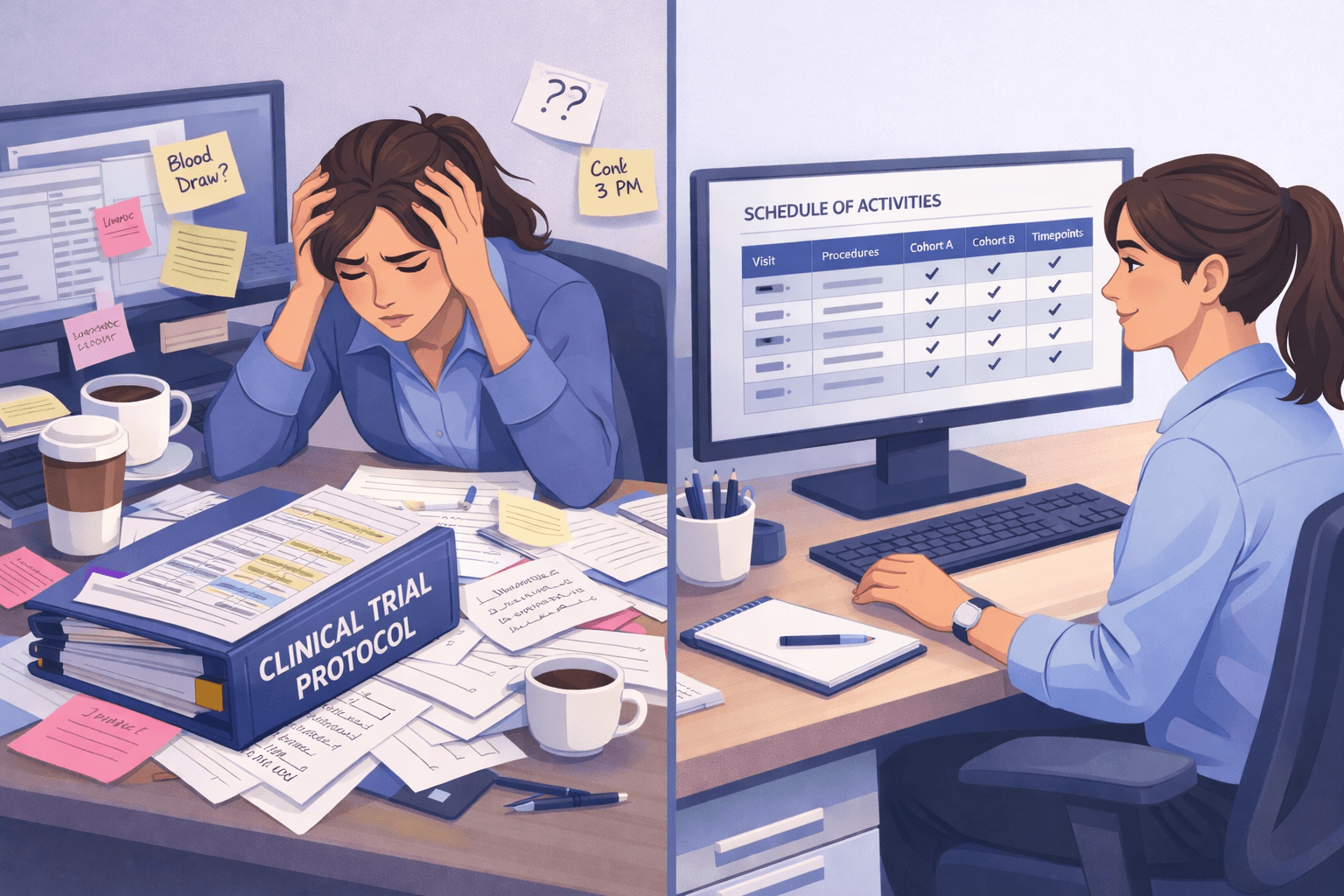
The documents sites work from every day, including the Schedule of Activities, source CRFs and the site protocol orientation reference, are also generated by Clinials Protocol Intelligence from the protocol. The SIV prepares the team; those documents carry the protocol into every visit.
How to get to >25% reduction?
A generated SIV deck will not deliver a 25% reduction on its own. The largest share of redundancy sits in EDC, IRT, safety system and portal training, and that requires reciprocity agreements between sponsors, CROs and vendors. No single product removes that.
Our contribution is to enable relevancy to the protocol. As redundant training is cut, the protocol specific training that remains carries more weight, not less. If it is slow to build, inconsistent across sites and impossible to verify, the hours saved on platform training are simply lost to deviations, queries and retraining downstream. Cut >25 succeeds only if both halves move together.
The time to act is now
SCRS has already moved from guidance to results, with its August 2026 status survey and outcome sessions at the Site Solutions Summits. Sponsors and CROs are being asked to show what they changed. Every study initiated under the old model between now and the next measurement carries the same deviation risk the data has already exposed.
Sponsors, CROs, Consultants: take your next protocol, generate the SIV in Clinials, and compare it with the deck your team would otherwise build by hand. Measure the hours to produce it, the questions sites raise, and the deviations in the first 90 days.
Start at clinials.com or book a walkthrough.
References
Society for Clinical Research Sites. Cut >25: Playbook for Reducing Clinical Site Training Burden. Guidance for Clinical Research Industry Partners. January 2026. Download
Society for Clinical Research Sites. Cut25: Cutting Redundant Site Training by 25%. Programme page, updated September 2026. myscrs.org/advocacy/cut-25
Society for Clinical Research Sites. Leading the Cut: 4 Organizations Take on Site Training Reduction. April 2026. myscrs.org
Society for Clinical Research Sites. Reducing Site Training Burden: Results From Cut 25. Site Solutions Summit session, October 2026. sitesolutionssummit.com