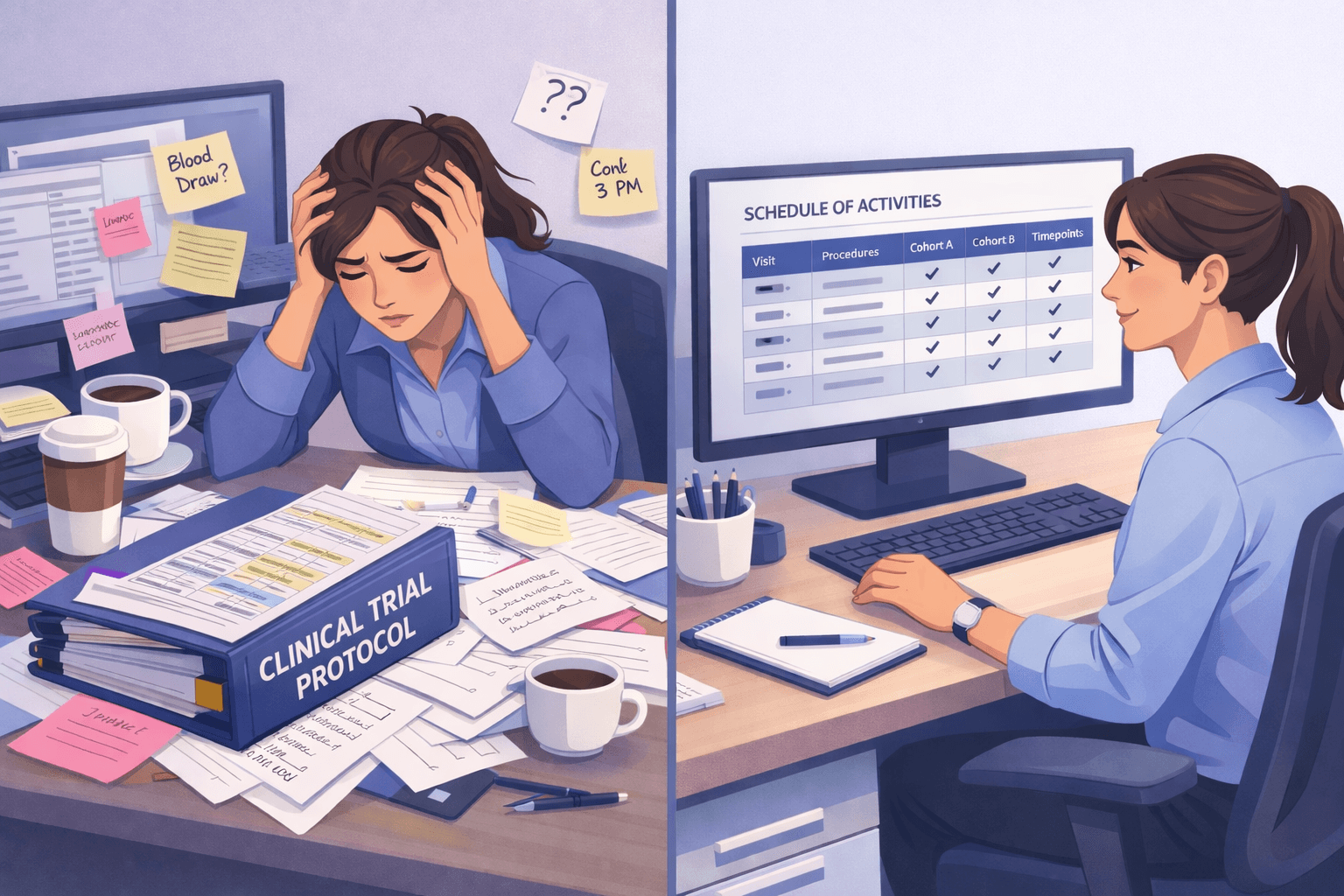
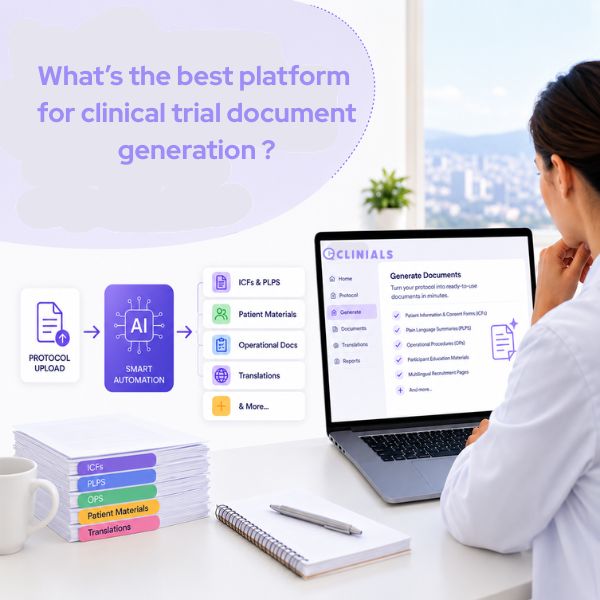
Every trial team lives with protocol amendments. What has stayed manual, expensive, and largely invisible is the step before the rebuild: working out precisely what changed, what it affects, and whether every site is even working from the same version. Clinials now generates that answer directly from the protocol.
I have written before about the document side of a protocol amendment: the informed consent forms, patient information sheets, training materials, and billing worksheets that a site has to rebuild from scratch once an amendment lands. Mostly uncompensated work. But it is only half the problem, and arguably not the harder half.
Protocol amendments. Nobody budgets for them. Every site lives them. The sponsor has absorbed the cost of the amendment. The site absorbs the rest.
Before a coordinator, a CRO study manager, or a sponsor clinical operations lead can even start on the rebuild, someone has to answer what, exactly, changed between this version of the protocol and the last one, and what does each change touch? It's rarely simple question to answer across multiple sites and a CRO.
Until now it has almost always been answered by hand with two PDFs open side by side, redlining language, and cross referencing against every downstream document already in the field.
What is the cost of "what changed"? |
|---|
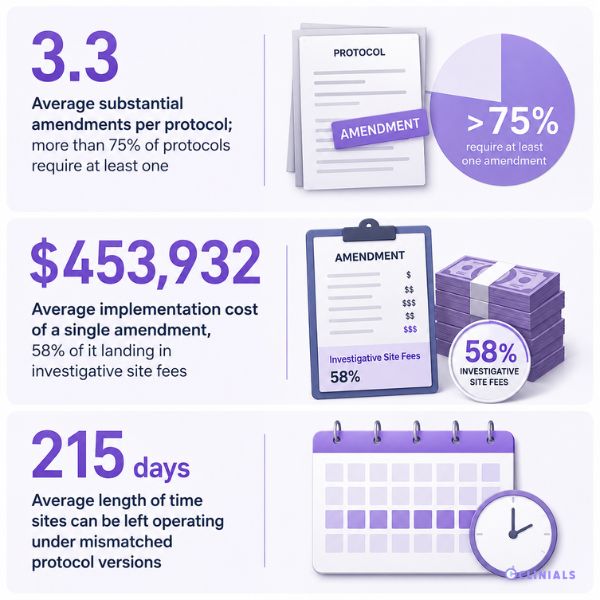 |
Amendments are not rare and usually not small. More than three quarters of protocols require at least one substantial amendment, and the average protocol carries 3.3 of them over its life.
ACRP Article by Trevor Cole and Jessica Thurmond WCG Clinical Researcher Article quoted
More than 75% of clinical trial protocols require at least one substantial amendment, with an average of 3.3 amendments per protocol.
These amendments are not benign with Phase III amendments alone can introduce nearly three months of delay and up to $1 million in unplanned direct costs per amendment.
Are trial teams taking amendment management seriously?
Implementation Costs
Each updated protocol carries a real implementation cost, and site fees are consistently the largest single component of that cost, ahead of CRO change orders.
Operational Costs
Clinical research professionals overwhelmingly report timeline delays connected to amendments, and sites can be left running on an outdated protocol version for months at a time simply because nobody had a fast, reliable way to confirm what had changed and where.
Manually comparing two protocol versions section by section, then tracing each change through to consent forms, source documents, and site materials already in the field, is slow, easy to get wrong, and has to be repeated by every site and every reviewer touched by the amendment. It is also a real contributor to the delays that affect the large majority of trials in progress.
The sponsor absorbs the cost of the amendment. Historically, the site absorbed the cost of finding out what the amendment actually meant.
What the Clinials Delta Report does!
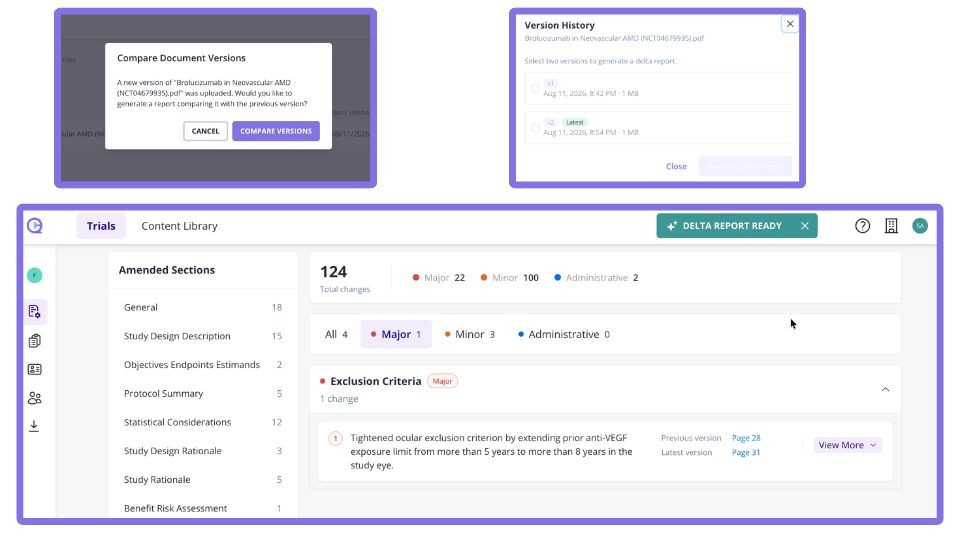
Clinials now lets you select two versions of a protocol and generate a Delta Report. It is built to answer the "what changed" question directly from the source document, not from a manual redline.
Every section of the protocol that changed between the two versions
The precise before and after language, side by side
Each change categorised as major, minor, or administrative
The downstream impact of each change
Page references back to the source protocol documents
The categorisation matters as not every amendment carries the same weight, and treating a wording clarification the same way as a change to eligibility criteria or the schedule of activities is exactly how review time gets wasted on the wrong things. Separating major changes from minor and administrative ones lets a team direct its attention, and its budget, to where the amendment actually requires it.
For sponsors and CROs
A clearer, faster way to assess amendment impact across a study and manage the downstream documentation burden it creates, before that burden reaches every site individually.
For sites
Less time spent manually comparing protocol versions and working out which documents need to change, and less uncertainty about whether the version in front of a coordinator is actually current.
See what changed, then update the documents, in one platform
The Delta Report is the first step, not the whole workflow.
Clinials already generates a site's complete startup document suite directly from a protocol upload, informed consent forms, patient information sheets, schedule of activities, and source case report forms. When an amendment arrives, the same platform that produced those documents the first time can now tell you exactly what changed, then regenerate the documents that change actually touches.
Protocol in. Changes identified. Documents updated. Less manual reconciliation, less version uncertainty, and a faster path from amendment to an implemented, compliant document set.
None of this requires a technology project. There is no integration with your existing CTMS, EDC, or eTMF platform, no implementation period, and no disruption to validated infrastructure already in place. The first amendment you run through it is the comparison that makes the case.
See exactly what an amendment changed, and update the documents it affects, in the same session.
Clinials generates a Delta Report from any two protocol versions, then regenerates the affected consent forms, patient materials, schedule of activities, and source documents directly from the amended protocol.
Start with a free trial at clinials.com.