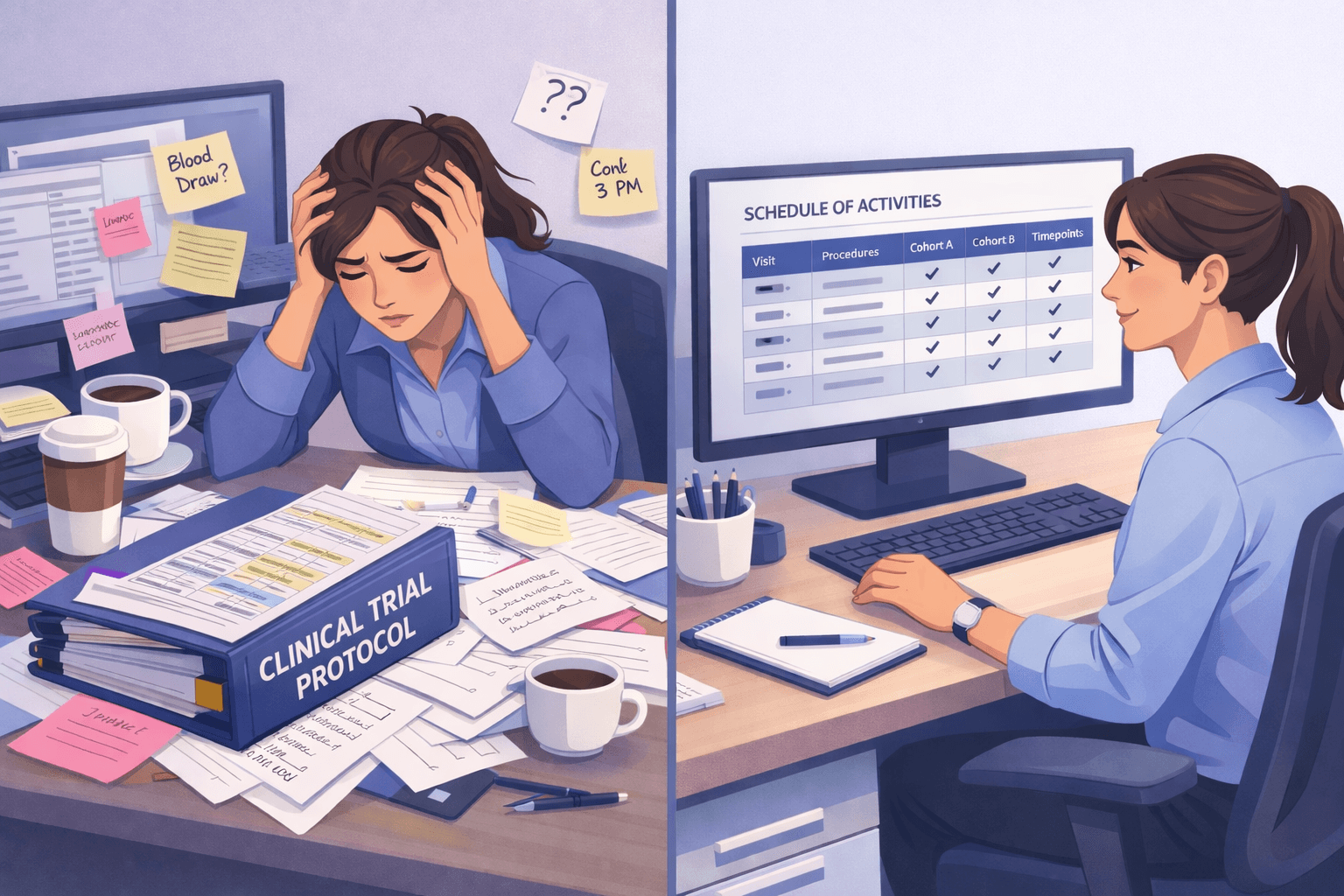
If your days, in clinical trials and research, feel like a constant cycle of documentation, system logins, emails, and firefighting, you’re not imagining it.
And no, it’s not because you’re disorganized, inefficient, or “not managing your time well enough”.
The reality is simpler, and harder: the work itself has changed. Clinical trials are more complex than they’ve ever been. Protocols are longer. Endpoints are harder to operationalize. Documentation expectations keep growing. Systems keep multiplying.
Time, headcount, and thinking space, on the other hand? Not so much.
It’s not you. It’s the structure.
Many clinical teams are quietly carrying a sense of personal failure:
“If I were better organized…”
“If I just worked faster…”
But what we see, again and again, is this:
“Overload in clinical trials is no longer about individual performance.
It’s the shape of the work itself.”
As the structure is overloaded, effort alone is not going to fix it.
When documentation stops being “admin” and starts draining your brain
Documentation used to be time-consuming. Now it has become mentally expensive.
Protocols regularly run 100-200 pages. Every downstream document must stay perfectly aligned. One small change can ripple through multiple files, teams, and systems. That constant need to reconcile, cross-check, and correct does not just take time, it eats into your ability to think. And that’s the real problem.
“It’s not the busy work that breaks people.
It’s losing the time to actually think.”
The quiet loss no one talks about: thinking time
Some of the most important work in clinical trials can’t nor shouldn’t be rushed.
Is this study actually feasible?
Does this endpoint make sense in the real world?
Should we push back, now, before this becomes an amendment?
And many more of those questions that require quiet, focused thinking time. But with the day filled with meetings, document revisions, emails, and admin, that space disappears. Decisions become reactive. Risks are spotted later. Quality quietly suffers.
Not because people don’t care but because they’re stretched too thin to step back.
Consultants can help… or make things worse
When workload peaks and immediate help is needed (people with the right mix of skills, experience, and industry knowledge) consultants are often brought in as relief.
Sometimes that works beautifully. Some other times, it doesn’t.
The difference usually comes down to one thing: how they show up.
The best consultants:
Listen before prescribing
Fit into your existing SOPs and workflows
Reduce your cognitive load instead of adding another layer
The worst ones:
Arrive with a fixed model
Require heavy onboarding
Create more meetings, more documents, more explaining
As one speaker put it in our recent webinar: (See it here)
“The best consultants listen to the questions first, not arrive with all the answers.”
If you’ve ever felt that bringing in help somehow created more work, you’re not alone. Consultants and other seasoned professionals may prove invaluable and the reason why clinical trials - or research - actually succeeds instead of getting stuck by lack of time, resources, or collaboration. But, as with everything, this is not the “always-right” answer.
A word about AI and automation (without the hype)
AI gets talked about a lot as the answer to overload. And yes, when it’s done well, it can be genuinely transformative.
But many individuals have also had diverse experiences.
A tool produces something that’s almost right. You then spend hours fixing, checking, aligning, and validating it… and end up wondering if it actually saved you any time at all
In regulated environments, that matters.
“If you spend more time fixing the output than you saved, that’s not automation.”
What actually helps is technology that offers a valuable - and validated - improvement:
Removes duplicate data entry
Maintains consistency across documents
Reduces the mental effort needed to keep everything aligned
Reliability beats novelty. Every time.
So… what actually helps?
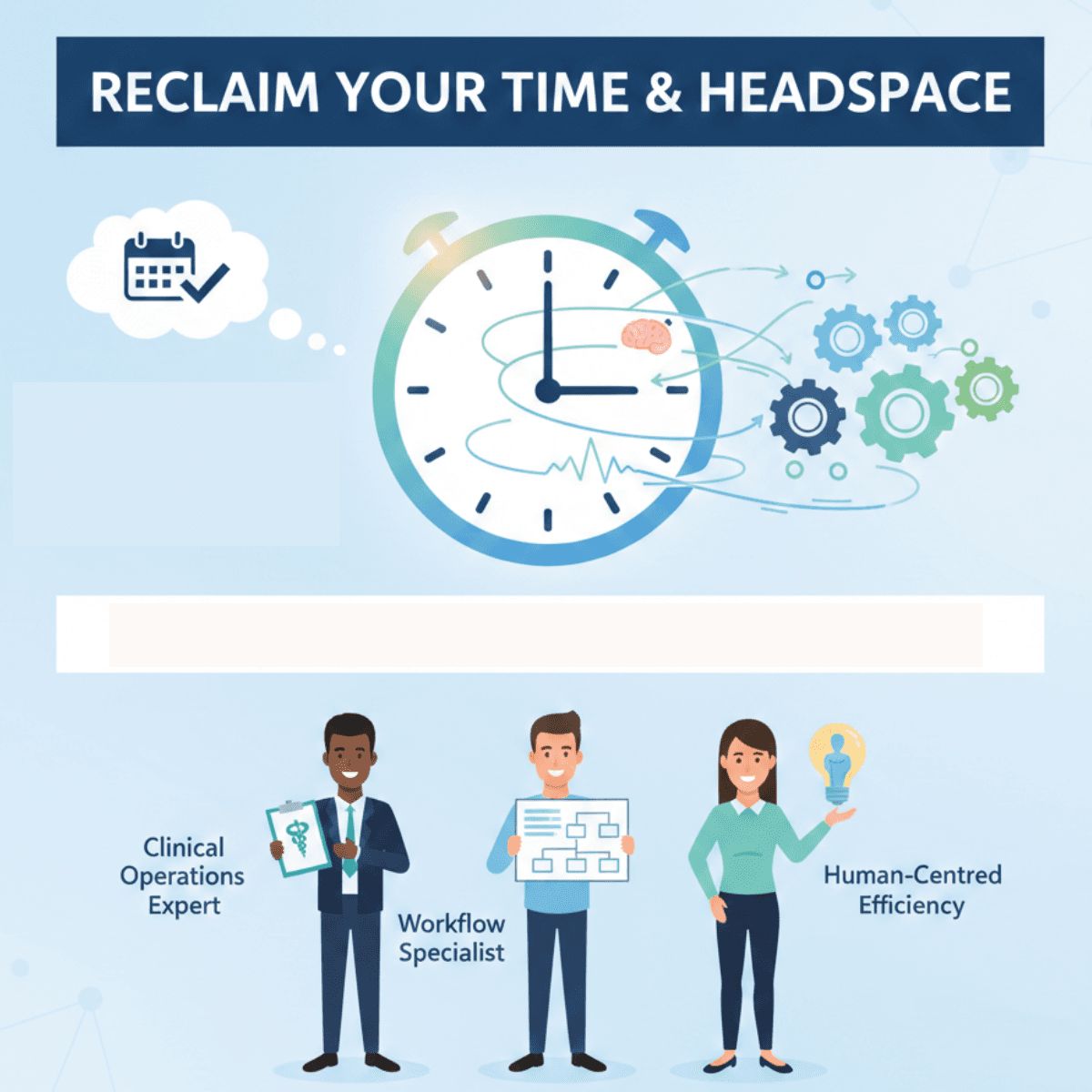
First, when we talk about reclaiming time in clinical trials, the point isn’t about squeezing more out of already full days. It’s about removing friction and reducing cognitive load.
That might look like:
Automating the most repetitive, transactional documentation work.
Ensuring changes flow consistently across trial materials.
Using consultants who leave clarity behind, not dependency.
Choosing tools that give you confidence, not more checking to do.
Most of all, it’s about giving experienced professionals their thinking space back.
Because with that, better decisions follow. And better trials follow those.
If you need a hand
If any of this sounds familiar, you’re not behind, you’re responding to a system that’s become heavier than it should be.
There are ways to take pressure off without compromising quality or compliance. And you don’t have to figure them out alone.
That’s the conversation we’re continuing, one practical step at a time.
And we invite you to trial one of the tools that give you confidence, not more checking to do: Clinials.
Start generating plain language and ready-to-use documentations, aligned with the protocol, for $145 a month.