BIO 2026: The Convergence of AI, Clinical Trials, and the Time to Trial That the Industry Can No Longer Ignore
BIO 2026 opens with a question every organisation in this industry should answer honestly: what is the unwavering conviction driving your work? For me the answer has been consistent since day one. Behind every protocol is a patient. And every week lost between that protocol and the first enrolled participant is a week that patient cannot afford.
There is a version of attending BIO International Convention that is about visibility, about being seen in the right rooms with the right people. Breakfast walks, round tables, back to back speed dating partner meetings and late into the night networking. That version has its uses and exists at most conferences. But why go to Bio this year in San Diego in June.
The reason is the BIO 2026 theme itself, and the question it asks of every company that walks through the doors of the San Diego Convention Center.
DRIVEN by Purpose
This is the force that unites us — not the pursuit of status or stability, but the unwavering conviction to solve the impossible, to push boundaries, and to achieve better outcomes for patients, public health, and the world. BIO 2026 is where we return to this essential “why.” It is our opportunity to reconnect as a global community, to recharge our commitment, and to remember that behind every innovation is a shared mission: to improve lives.
When you work in clinical trial as I do, this is why we turn every day. Because the people in this industry who are closest to that shared mission, the site coordinators running study startups, the principal investigators managing patient relationships, the sponsors funding trials that may take a decade to reach market, are also the people absorbing the most friction between a protocol and a patient.
Purpose-driven language is easy at a convention. The harder question is whether the operational infrastructure of clinical research actually reflects the urgency that improving lives requires. I don't believe it does. I'm attending the BIO 2026 program, across 135 sessions in 18 focus areas, to surface exactly why.
The Gap Between Purpose and Process
Tufts Center for the Study of Drug Development data is unambiguous: 85% of clinical trials experience delays. The direct cost of a single delayed Phase III day is $55,716. The median time from protocol finalisation to first patient enrolled at academic sites is 9.4 months. These are not statistics about drug discovery or regulatory science. They are statistics about the operational machinery that sits between a finished protocol and a patient who needs the therapy it describes.
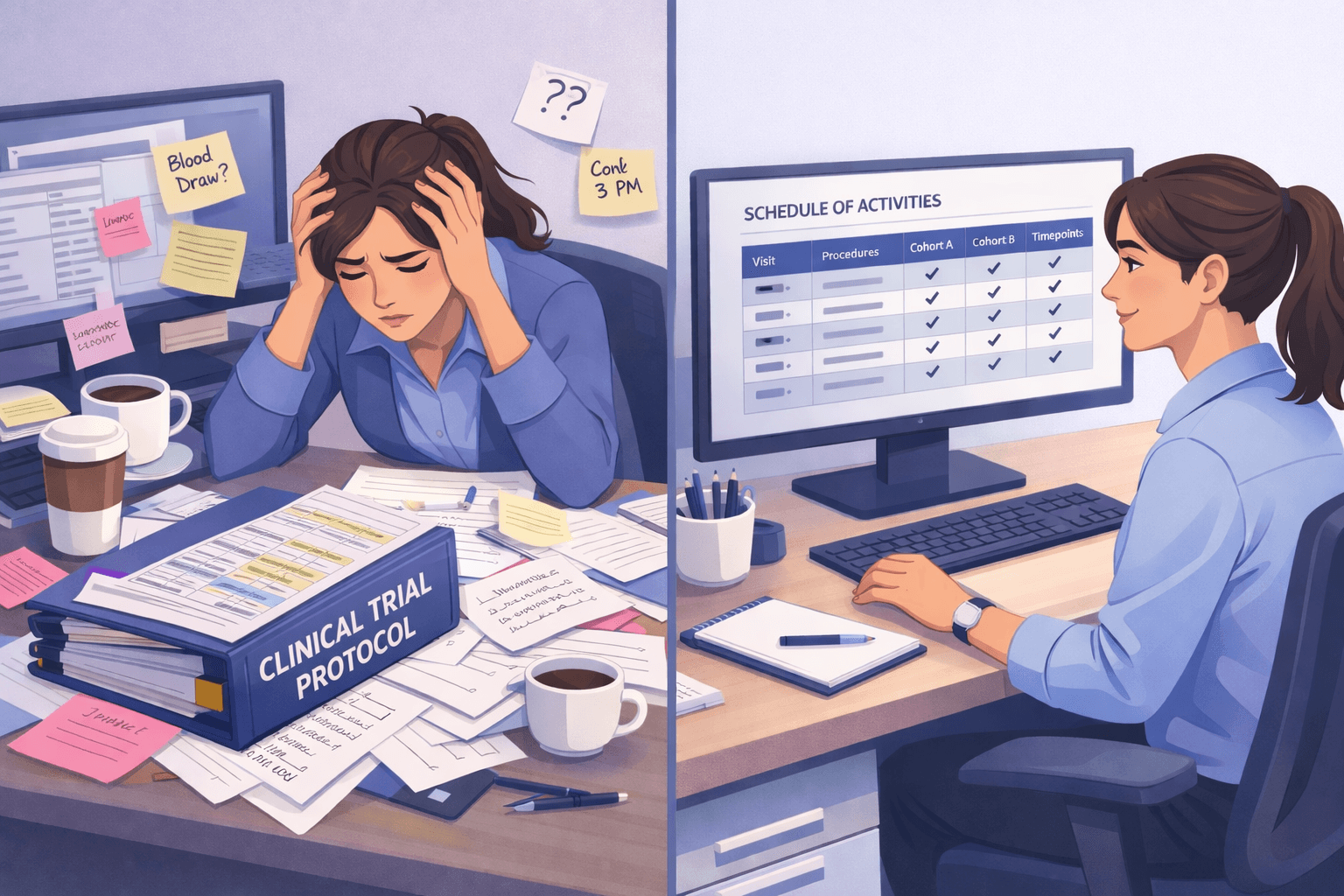
That machinery is, in large part, manual. Someone reads the protocol. Someone writes the informed consent form. Someone generates the schedule of activities. Someone builds the source CRFs. Someone produces the plain language summary. Someone creates the feasibility document the site needs to decide whether it can even run the study.
At high-complexity oncology sites, CRIO 2025 data from 209 sites puts the coordinator burden for that document generation at 40 hours per study activation. One full working week, before a single patient is screened. Across four activations per year, that is 160 hours of coordinator time consumed by documentation that could be generated from the protocol in minutes.
85%Of clinical trials experience delays; startup documentation is consistently cited as a primary driver
$55,716 Direct cost per day of Phase III trial delay (Tufts CSDD 2024); startup efficiency is directly material to drug development outcomes
40 hrsCoordinator burden per high-complexity oncology study activation for document generation
This is the gap between purpose and process. The industry is united by a conviction to improve lives. The operational infrastructure of clinical research adds months to the journey from protocol to patient. Let's talk about this at BIO 2026
Purpose without infrastructure is aspiration. The work of BIO 2026 is not to reaffirm why this industry exists. It is to close the distance between that why and the operational reality that patients experience on the other side of every delayed activation.
The Patient Who Is Waiting
There is a reason the BIO 2026 theme returns to the patient. Because the patient is the accountability that every other conversation in this industry is ultimately answerable to. Back to the Why??
The 18 BIO 2026 focus areas that lead us to the waiting Patient
Here's the lens I will have to these:
AI and Digital Health
The central question at BIO 2026 is not whether AI belongs in drug development. It is whether AI has moved from pilot to production in clinical operations. Clinical document generation is where that transition is most measurable: either the coordinator is spending 40 hours on documents, or they are not.
Oncology
Oncology trials carry the highest per-study coordinator burden in startup. Sites are declining oncology studies not because they lack interest, but because they lack capacity to process the activation documentation. The purpose of an oncology trial is to reach a patient faster. Manual startup documentation works directly against that purpose
Patient Advocacy
Plain language summaries and accessible informed consent forms are the direct connection between a clinical protocol and a patient's ability to make an informed decision. When those documents arrive weeks late because they were produced manually, the patient advocacy community has less time to engage. The documentation problem and the patient access problem are the same problem.
Science and Regulatory Innovation
EU CTR 536 plain language enforcement has converted a best-practice aspiration into a compliance requirement. FDA inspection data shows inadequate case histories as the second most cited deficiency. Regulatory innovation cannot outpace operational readiness, and operational readiness begins with the documents that are generated from the protocol.
Cell and Gene Therapy and Genome Editing
CGT protocols are among the most demanding to translate into compliant activation documents. The complexity that makes these therapies transformative is the same complexity that makes manual document generation an acute operational bottleneck. Automation changes what is operationally feasible in these programs, and therefore how many patients can access them.
Orphan and Rare Diseases
Rare disease trials serve patient populations that are, by definition, small and hard to reach. Every week of startup delay narrows the recruitment window. Plain language summaries and accessible prescreening tools are not administrative outputs in rare disease trials. They are the instruments through which eligible patients find their way to a study that may be their only option.
Business Development and Investment
Capital follows execution capability. At BIO 2026, the BD and investment conversations will increasingly include questions about operational differentiation during study startup. Sites that activate faster, CROs that distribute documentation faster, sponsors that convert protocols to activated studies faster: these are the organisations demonstrating that their purpose is backed by infrastructure.
Emerging Opportunities in Global Markets
Global trial expansion works across geographies, languages, and regulatory frameworks simultaneously. The purpose of reaching more patients in more markets is undermined when the operational infrastructure of multi-country startup still runs on manual document preparation in each jurisdiction.
What We Are There to Hear
With 135 sessions across 18 focus areas demands deliberate choices. The conversations worth attending are the ones that surface what is actually changing, on the ground, in the organisations carrying the weight of purpose into clinical operations every day.
AI implementation in clinical operations: pilot to productionThe BIO AI Summit and the AI and Digital Health sessions will hopefully surface where genuine production adoption is happening in clinical document generation and where the industry remains stuck in proof-of-concept mode. The distance between those two states is the distance between purpose and outcome for the patients waiting on the other side of study startup.
What biotechs are experiencing on the ground with FDA real-time clinical trials
One of the conversations we are most interested in at BIO 2026 is the unfiltered biotech perspective on FDA's real-time oncology and rare disease trial frameworks. The policy positions are documented. What is less visible is how biotechs are actually navigating accelerated approval pathways, what the operational pressure on site documentation looks like when regulatory timelines compress, and whether the infrastructure supporting those trials is keeping pace with the ambition.
Site capacity as a constraint on patient accessThe oncology and rare disease sessions at BIO 2026 will be attended by sponsors and CROs who are already feeling the ceiling that site coordinator capacity puts on how many studies can activate in parallel. What the industry is doing, and what it is not yet doing, to address a constraint that is fundamentally a documentation workflow problem is a question the program will approach from multiple angles.
Regulatory obligations and the plain language standardThe Science and Regulatory Innovation sessions address a period of significant transition in documentation obligations. EU CTR 536, FDA inspection priorities, and ICH harmonisation are live issues with direct implications for how clinical trial documents are generated, validated, and submitted. How the industry is responding to obligations that are no longer future-tense is the question worth tracking across the full program.
Patient advocacy and the documentation connectionThe Patient Advocacy track at BIO 2026 connects the patient access agenda to the operational infrastructure that either enables or obstructs it. Plain language summaries, accessible informed consent, and online prescreening tools are not peripheral to the patient advocacy mission. They are the operational expression of it, and BIO 2026 is one of the few venues where that connection is examined at the level it deserves.
Why Attend BIO 2026
The clinical trial operations community deserves coverage of this convention from inside the rooms where the relevant conversations are happening. The gap between startup documentation as it is currently practiced and as it could function with purpose-built technology is not well understood outside the people living it. Site coordinators know it. Principal investigators know it. Sponsors watching activation timelines slip past nine months know it.
BIO 2026 is where those people are in the same room as the biotechs funding the trials, the regulators shaping the frameworks, the investors setting the terms, and the patient advocates holding the whole enterprise accountable to the outcome it exists to deliver. That convergence does not happen often. The purpose-driven theme of the convention raises the stakes for what those conversations should produce.
If you are attending BIO 2026 and working on study startup, patient access, AI implementation in clinical operations, or the regulatory documentation obligations that are now enforcement-stage, lets talk in San Diego. The industry gathers to recommit to the why. The how deserves equal attention in the same room.