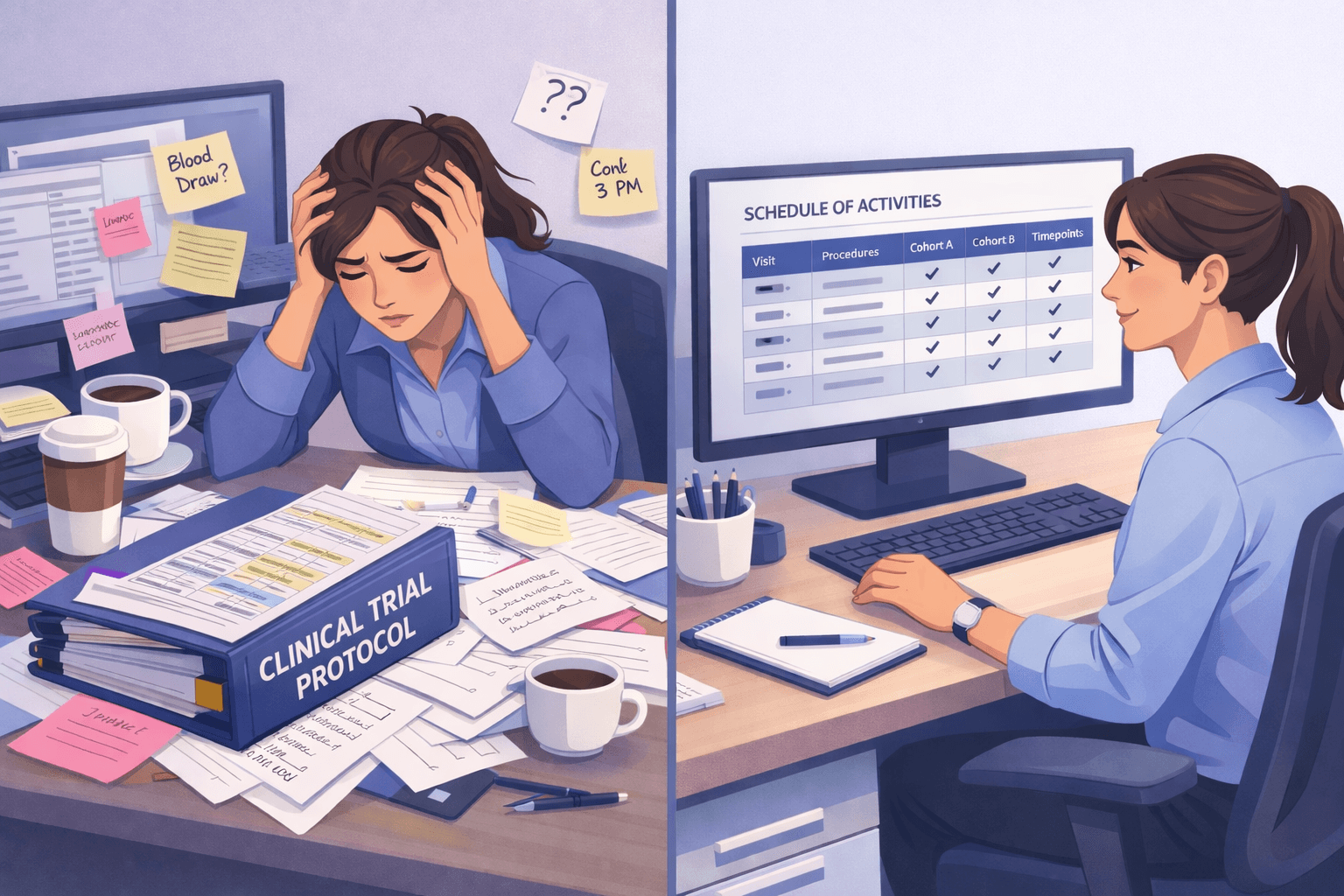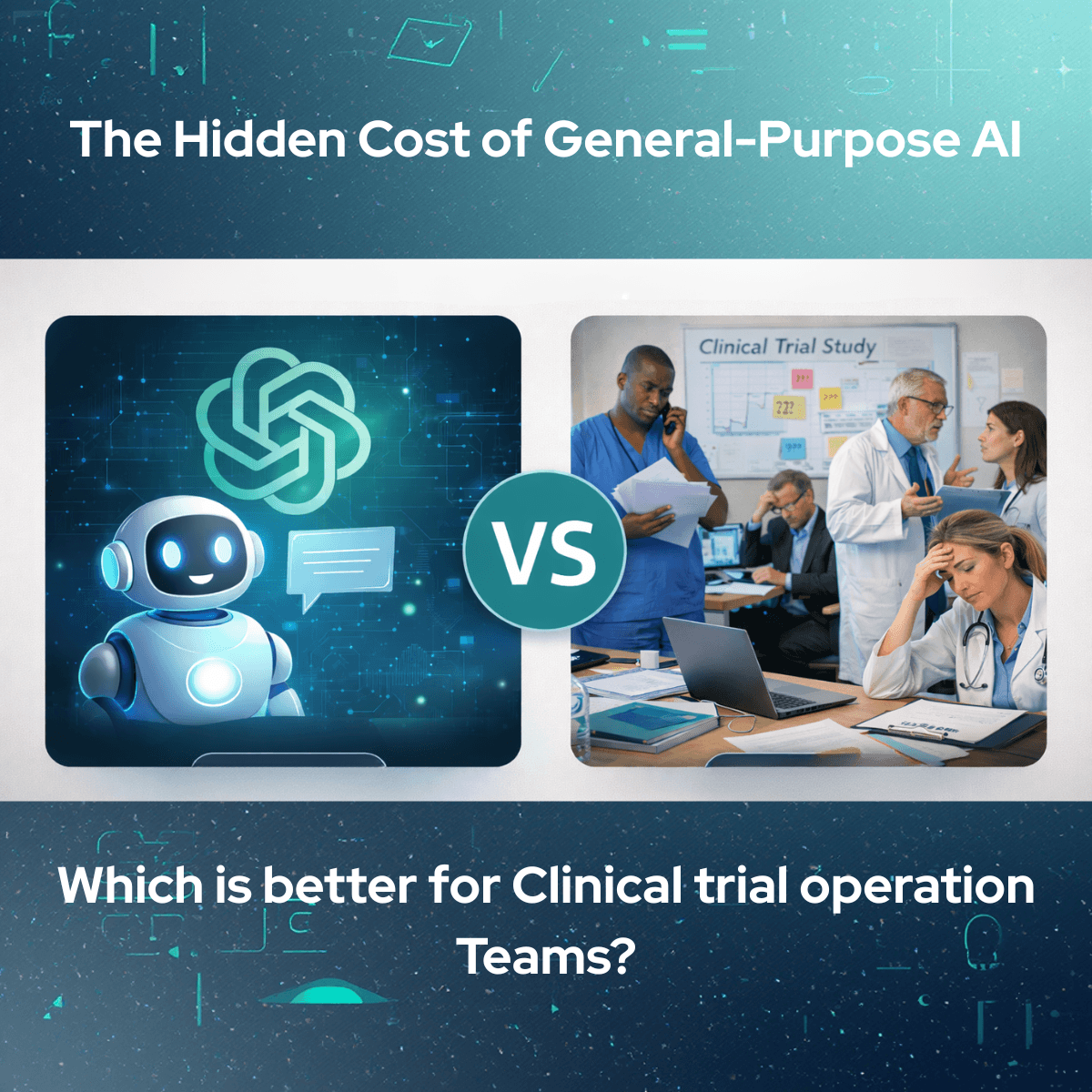
“Why not just use ChatGPT, Claude, Copilot etc?” Or "Which team member is best to start using Clinials"
Fair questions. My answer is usually "awesome that you have empowered your team members using these generic AI tools, and they are also the very same people who will love and should be using Clinials "
But lets re-ask this question based on our current under resourced and overburdened teams?
Why not just use ChatGPT? Or, more pointedly, “Which team member should we train to do prompting well?”
The hidden cost of prompting
Most teams underestimate what it actually takes to operationalise tools like ChatGPT or Claude in a clinical trial environment:
Time spent learning how to prompt effectively
Iteration cycles to get usable outputs
Rework due to inconsistency or missing context
Manual validation against the protocol
Variability across team members, sites, and regions
You don’t just pay for the tool. You pay for:
Training
Trial and error
Quality control
Rework downstream
And critically, none of that scales cleanly. Two coordinators using the same tool will produce two different outputs.
That variability is where timelines slip.
Cheaper” rarely is. Yes, general-purpose AI tools appear cheaper on paper. But in practice, the cost model looks like this:
Low subscription cost
High human effort
High variability
Ongoing supervision required
That’s not efficiency. That’s hidden labour.
Where Clinials shifts the equation
Clinials removes the need to “figure out prompting” entirely. Not because prompting isn’t powerful, but because teams shouldn’t have to become prompt engineers to run a trial.
Instead:
Protocols go in
Structured, workflow-aligned outputs come out
Consistently, every time
No interpretation layer. No variability between users.
The real comparison
ChatGPT or Claude or Copilot helps individuals think faster.
Clinials helps teams execute faster. That distinction matters.
Because clinical trials don’t fail on thinking, they fail on execution:
Misinterpreted protocols
Inconsistent site processes
Rework across documents and teams
What changes with Clinials
The impact shows up quickly:
No prompt engineering or setup time
Deterministic extraction of protocol-critical content
Outputs mapped to real clinical workflows, not generic text
Built-in traceability with citations back to the protocol
Consistency across teams, studies, and regions
In trials, speed isn’t about generating words, It’s about reducing rework, interpretation risk, and downstream delays.
The strategic question isn’t “which tool?”
It’s:
Do you want your team spending time learning how to ask better questions…or moving faster with answers that are already structured, governed, and usable?
Exec Summary
ChatGPT is general-purpose.
Clinials is single tenanted, secured, structured, repeatable, workflow-aware, and designed for regulated use, where context, consistency and governance matter. There's no sharing of data between accounts and there's no training on protocols.
ChatGPT is powerful. But in clinical trials, power without precision slows you down.
ChatGPT is a generalist. Clinials is purpose-built.
ChatGPT helps individuals think faster.
Clinials helps teams execute faster.
Clinials demonstrates instant ROI, with a low cost monthly subscriptions removing usage barriers for small sites
That’s why Clinials isn’t “ChatGPT for clinical trials.”
It’s infrastructure for clarity, so sites, sponsors, and patients can move with confidence. Generate clinical trial content from the protocol in minutes, not days.
AI will keep getting louder this year.
Execution is what will separate signal from noise.